.jpg)
Strengthening the Data Science Thread in Indiana
Inside Indiana’s Call to Action Summit on data science, workforce readiness, and the future of learning

Across Indiana, educators are reimagining what it means to prepare students for a data-driven world. There is a growing recognition that today’s learners need more than traditional math sequences alone. They need opportunities to reason with data, ask meaningful questions, interpret information, and apply quantitative thinking to real-world problems. From elementary classrooms to high school pathways, teachers are leading the shift toward learning experiences that connect math, science, social studies, and career-ready skills through real-world data.
That is why the Indiana Department of Education and Data Science 4 Everyone came together December 11, 2025 at the Garrison Event Center in Indianapolis to host the Indiana Call to Action Summit: Strengthening the Data Science Thread. This convening brought together educators, higher education leaders, policymakers, and industry partners from across the state with one shared goal: imagining a future where every Indiana high school graduate can confidently navigate a data-driven world. As Rick Hudson, Professor of Mathematics at the University of Southern Indiana, reflected, “At the end of the day, it was clear we have a lot of work to do to ensure employers in Indiana have the data-literate employees they need. As educators, we need to prepare students for the data-rich world they’ll encounter.”
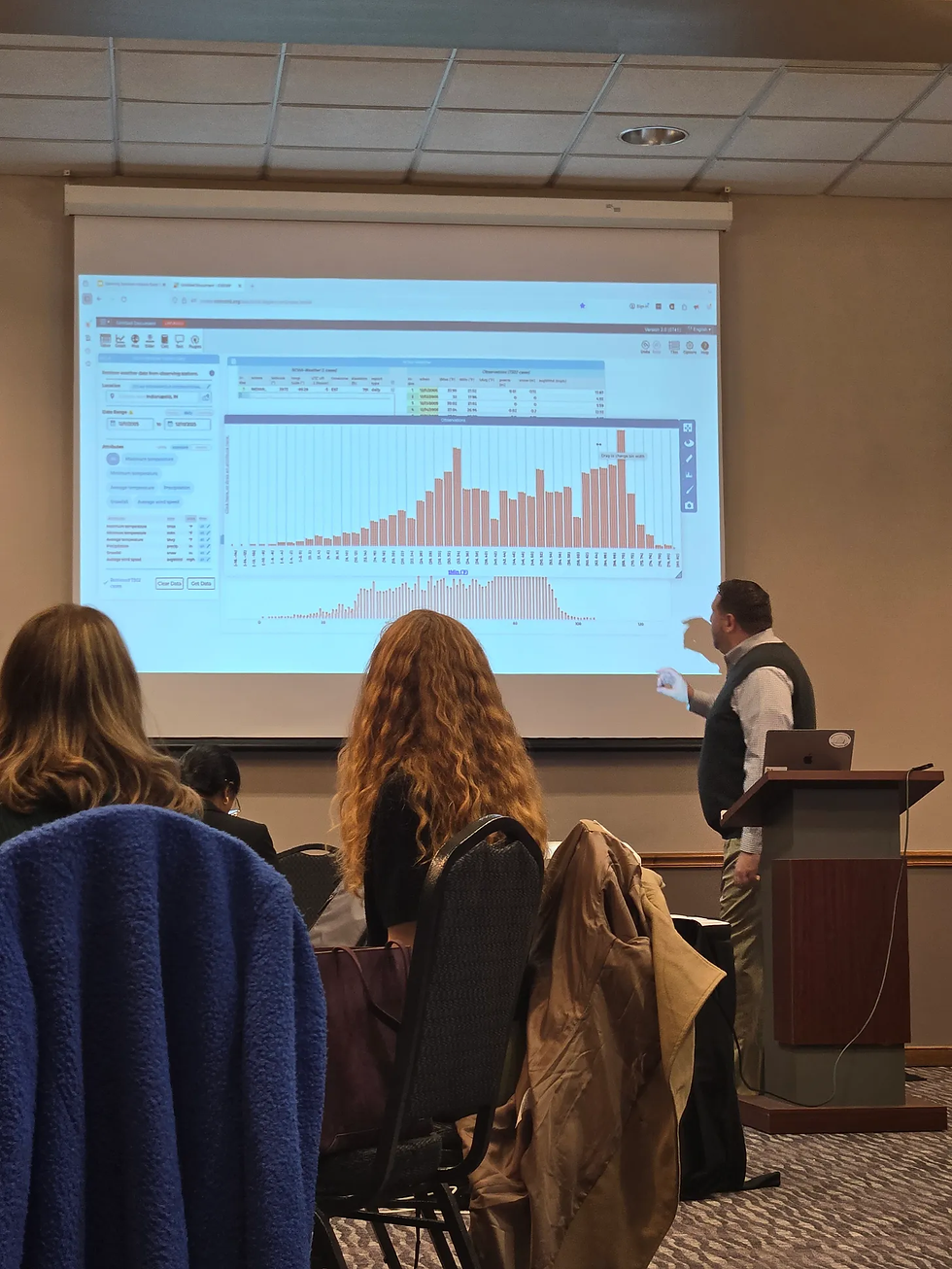
The day began with an opening message from Dr. Hudson, who emphasized the importance of data literacy for all students and the role of the data process in helping learners make sense of the world around them. To bring this idea to life, he led participants through a hands-on demonstration using a “slow reveal” graph from the New York Times’ What’s Going On in This Graph? series. Attendees explored two related graphs—one showing the percentage of U.S. weather stations breaking all-time temperature records and another mapping where those records were set—without initially being told how the datasets were related. Participants were challenged to look for relationships, ask questions, and form hypotheses. Once participants formed their own hypotheses, Dr. Hudson showed them how to test those ideas by collecting the same weather data and using CODAP to build a map of median daily maximum temperatures by month, modeling the kind of inquiry-driven, data-rich learning experiences that can transform classrooms.

The program then continued with a presentation from Zarek Drozda, Executive Director of Data Science 4 Everyone, who expanded on what data science can look like across K–12 education. Drozda introduced the newly developed K–12 Data Science Learning Progressions, the first comprehensive set of national guidance designed to build a data science mindset in students throughout their education, and highlighted how this work can dovetail with the efforts already underway in Indiana to integrate data science across subjects and grade levels.
This was followed by the Data Science Beyond the Classroom panel, moderated by Shellie Hartford, Director of Curriculum & Instruction at the Indiana Department of Education, and featuring Mike Steele, Chair of the Department of Educational Studies at Ball State University; Hong Gao, Managing Director at ClearPath Insights LLC; and Mark Daniel Ward, Executive Director of The Data Mine at Purdue University. Together, the panelists explored why data science is becoming a foundational skill across K–12 education, higher education, and industry, with a focus on the needs of Indiana’s future workforce.
Reflecting on the significance of this gathering, Mike Steele shared, “It was exciting to see such a diverse set of teachers, faculty, and leaders from across the state in the same room to talk about the importance of data science and data literacy. We have long known that data is an important idea for our students, but too often these efforts have not been fully realized.” He also emphasized the urgency of rethinking secondary mathematics, noting, “The customary high school mathematics sequence is not working for most of our students. Integrating data science across the secondary spectrum has great potential to make mathematics more meaningful and to better prepare students for their futures.”

Throughout the day, participants also engaged in hands-on work that went far beyond traditional conference sessions. Educators explored the national learning progressions, examined models from other states, reviewed Indiana’s current standards and programs, and worked in grade-band breakout groups to identify where data science already lives in their classrooms and where new opportunities could emerge. In the K–8 breakout, educators discussed why data science education is especially crucial in early learning environments and explored next steps for classroom integration. In the 6–12 breakout, secondary educators connected the learning progressions to their content areas and helped shape Indiana’s next steps for high school data science education.

Lin Chu, PhD candidate in Instructional Systems Technology at Indiana University Bloomington and an event participant, shared about her experience working with the K–8 grade-band breakout session, where educators analyzed the data science learning progression competencies and explored how they connect across subject areas:: “At the end of the summit, our K–8 group divided into three smaller groups and reviewed the data science learning progression competencies across different grade levels. Our goal was to determine whether each competency could be connected to specific subject areas…For me, this experience sparked a strong interest in exploring integration ideas in non-STEM subject areas with other educators at the summit. I shared my contact information and connected with an outstanding STEM specialist to continue these conversations and pursue future collaboration.”
The summit concluded with a clear call to action, a shared sense of urgency, and next steps for the IDOE and all stakeholders present. Educators and higher education partners committed to one pedagogical change or implementation plan in their coursework, and IDOE is using feedback from the summit to create a report highlighting Indiana’s Data Science priorities to guide implementation in 2026 and 2027.
Sarah Wegener, an 8th Grade English/Language Arts teacher and summit participant said of her experience, “Before attending [the Call to Action Summit] I was looking to see how I could implement data science in my classroom. After attending I have a much deeper understanding of data science, and I am even more excited about presenting it to my fellow staff.”
As Hong Gao, Managing Director of ClearPath Insights LLC, reflected, “The future of education isn’t just about teaching students to use technology. It’s about empowering them to think logically, creatively, and responsibly in a world shaped by it.” Mike Steele also echoed this urgency: “Change to these traditional [educational] structures will take a sustained effort and a lot of political will, and this is what I see as the next important step for Indiana.” With new policy, growing momentum, and a shared commitment across sectors, Indiana is laying the groundwork for a future where every student graduates prepared to think critically with data and thrive in an increasingly data-driven world.